Unboxing the Top Sustainable Packaging Trends for 2025

Need Design Help?
After years of learning what brands need. I'm here to help.
Sustainable Packaging Trends That Actually Matter in 2026
Sustainable packaging trends are reshaping how brands design, ship, and sell their products — and in 2026, the pressure to get it right has never been higher. Whether you're a small food brand at a local farmers market or a product line scaling into retail, how your packaging looks and what it's made of is now a core part of your brand story.
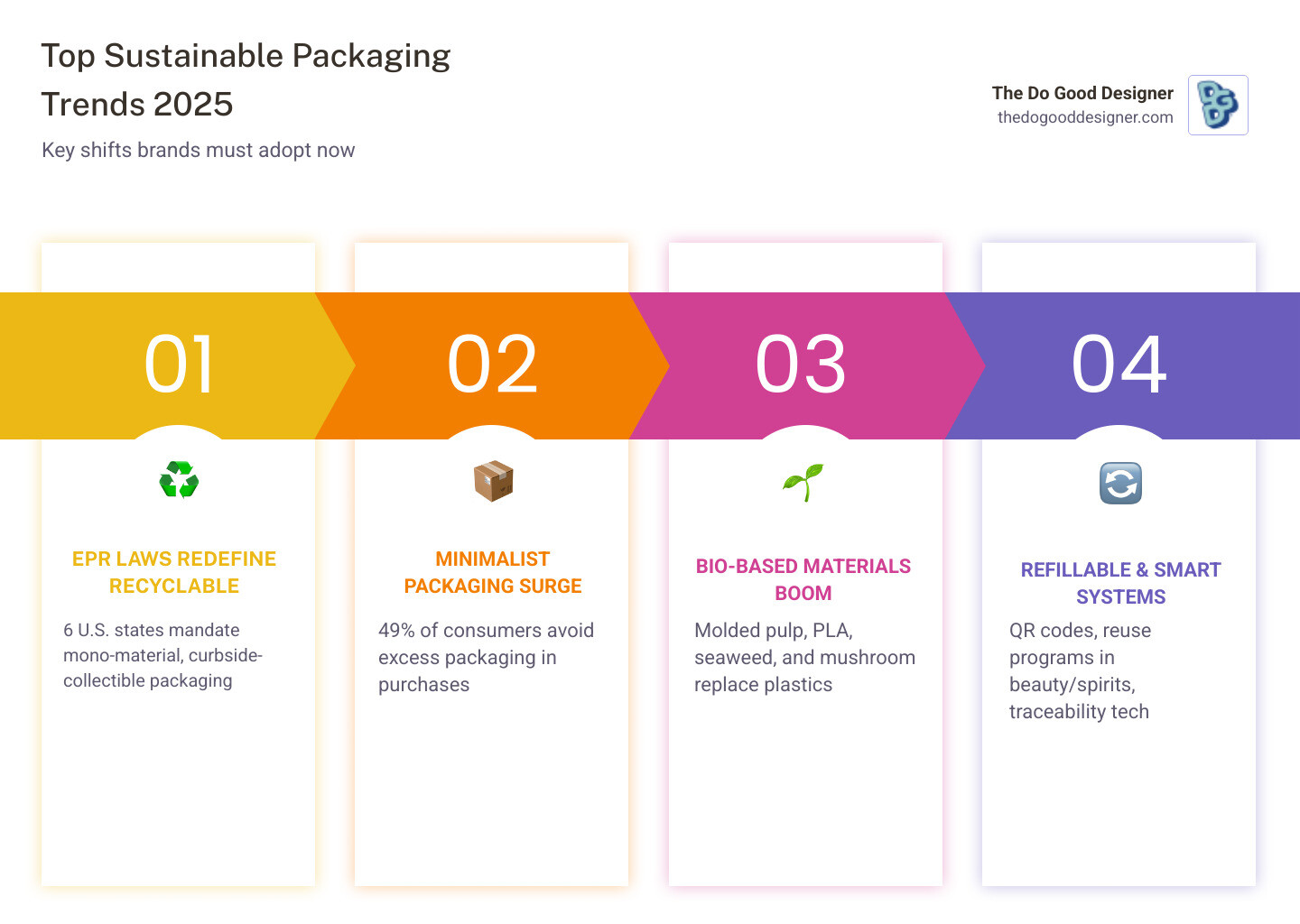
Here are the top sustainable packaging trends shaping 2026 and into 2027:
- EPR laws redefining "recyclable" — Six U.S. states now require packaging to be mono-material and curbside-collectible to qualify
- Minimalist packaging — Consumers are actively avoiding products with excessive packaging
- Bio-based and paper-based materials — Molded pulp, PLA, seaweed films, and mushroom-based packaging are replacing plastic
- Refillable and reusable systems — Especially in beauty and spirits, with city-scale reuse programs gaining traction
- Smart labeling — QR codes and hybrid labels that give location-specific recycling instructions
- Material health compliance — Brands phasing out PFAS, phthalates, and other toxic chemicals under tightening regulations
- Substantiated sustainability claims — Greenwashing is losing ground as regulations demand proof
The conversation around sustainable packaging has shifted. It's no longer enough to slap a leaf icon on a box and call it eco-friendly. Consumers are more skeptical, regulators are tightening the rules, and brands that can't back up their claims are getting called out — fast.
According to McKinsey, sustainability is becoming a purchase driver, not just a nice-to-have. Products with ESG-related claims show a clear performance advantage:
- 28% growth over five years for products with ESG claims
- 20% growth for those without
I'm Allie Rapp-Laing, a graphic designer based in Omaha, Nebraska, and packaging design is one of my favorite places to apply strategy — because good packaging that reflects sustainable packaging trends is as much about brand clarity as it is about materials. Here is what's actually changing and what it means for your brand.
How Policy and Consumer Shifts are Redefining Sustainable Packaging Trends
I’ve always believed that good design isn’t just decoration; it’s strategy. In packaging, that strategy is now being dictated by a massive shift in how people buy and how governments regulate. We aren't just talking about "feeling good" about the environment anymore. We're talking about ESG-related growth that shows sustainable brands are simply performing better in the marketplace.
For my fellow Midwest small business owners, this is an opportunity. When you align your brand with these values, you aren't just following a trend—you're building trust. People are looking for transparency. They want to know that the brand they’re supporting in Omaha or Lincoln cares as much about the planet as they do.
The Rise of EPR Laws and the New Meaning of Recyclable
One of the biggest shifts I’m seeing is the move toward Extended Producer Responsibility (EPR) laws. While these started as a coastal thing, they are quickly becoming the national standard for how we define "recyclable." States like Minnesota are joining the ranks of California and Oregon in passing legislation that puts the responsibility of a package's life cycle back on the brand owners.
What does this mean for your design? It means "recyclable" is getting a much stricter definition. To stay compliant, packaging often needs to be a mono-material—meaning it's made of just one type of plastic or fiber—so it can actually be processed by curbside systems. Research shows that 78% of U.S. consumers look at recycling info on labels before tossing things in the bin. If your packaging is a confusing mix of materials, it’s not just an environmental issue; it’s a brand frustration for your customers.
Why Consumers are Avoiding Excessive Packaging
We’ve all had that "Amazon moment" where a tiny item arrives in a massive box filled with plastic air pillows. It’s annoying, right? Well, it turns out that consumer sentiment is shifting toward minimalism:
- 49% of U.S. consumers are now actively avoiding products with excessive packaging.
- 50% of consumers now rank sustainability as a top purchase criterion.
When I work on food packaging design, I focus on how we can protect the product while using the least amount of material possible. Designing with a "less is more" mindset doesn't just save the planet—it saves you money on shipping and materials, too.
Material Health and the Phase-Out of Toxic Chemicals
Sustainability isn't just about where the package goes after use; it’s about what’s in it while it’s on the shelf. There is a massive move toward material health, specifically phasing out "forever chemicals" like PFAS, phthalates, and bisphenols.
Regulatory shifts are making this a requirement rather than a choice. Brands are now expected to perform due diligence to ensure their packaging isn't leaching harmful chemicals into their products. Whether I’m working on packaging projects for a local bakery or a national skincare line, ensuring the materials are safe and compliant is a baseline for any purpose-driven business.
Innovative Materials and Systems Leading the Way in 2026
As we navigate 2026, the innovation in materials is honestly mind-blowing. We are moving away from being "material agnostic" and toward very specific, high-performance eco-materials. The goal is a circular economy where the packaging never actually becomes "waste."
The Paperization Movement and Bio-Based Sustainable Packaging Trends
"Paperization" is a word you’re going to hear a lot. It’s the shift from plastic films and trays to fiber-based alternatives. We’re seeing molded pulp (think egg cartons, but way cooler and more high-end) being used for everything from electronics to luxury beauty.
Bio-based materials are also taking center stage:
- Mushroom-based packaging (made from mycelium): Backyard-compostable and breaks down in weeks.
- Seaweed films: Replacing traditional plastic wraps.
- PLA (polylactic acid): Made from corn starch and used for compostable containers.
When you look at my packaging services, you’ll see that I love helping brands explore these textures. They feel organic, premium, and intentional.
Refillable Systems and Smart Tech in Sustainable Packaging Trends
The most sustainable package is the one you don't throw away. Refillable systems are booming, especially in the spirits and beauty sectors. Think about a high-end gin bottle that you keep on your bar, but buy a low-waste refill pouch for when it’s empty. Or skincare jars where you just swap out a "pod" instead of buying a whole new heavy glass jar.
To make these systems work, we're seeing an explosion in smart tech. QR codes are being used to provide location-specific recycling instructions or to track "Digital Product Passports" that show the entire life cycle of the materials. It turns a passive box into an interactive brand touchpoint.
Designing for the Future with The Do Good Designer
I’m a firm believer that the world needs less boring—and less wasteful—packaging. At the end of the day, your packaging is the first physical interaction a customer has with your brand. It should tell them exactly who you are and what you stand for.
I started The Do Good Designer here in Omaha because I wanted to help purpose-driven brands stand out through bold, strategic design. Whether we’re talking about a brand-new logo or a full-scale packaging overhaul that follows the latest sustainable packaging trends, I’m here to make sure your brand is unmistakable and long-lasting.
If you’re ready to move beyond generic boxes and create something that actually reflects your vision, check out my packaging services. Your size doesn't matter—your vision does. Let’s build something that does some good.