Social Media Superstars: Who is Actually Winning the Feed?
Need Design Help?
After years of learning what brands need. I'm here to help.
Who's Actually Winning on Instagram Right Now?
The best brands on Instagram aren't just posting pretty pictures. They're building real communities, driving purchases, and turning followers into loyal fans.
Here's a quick look at who's leading the pack:
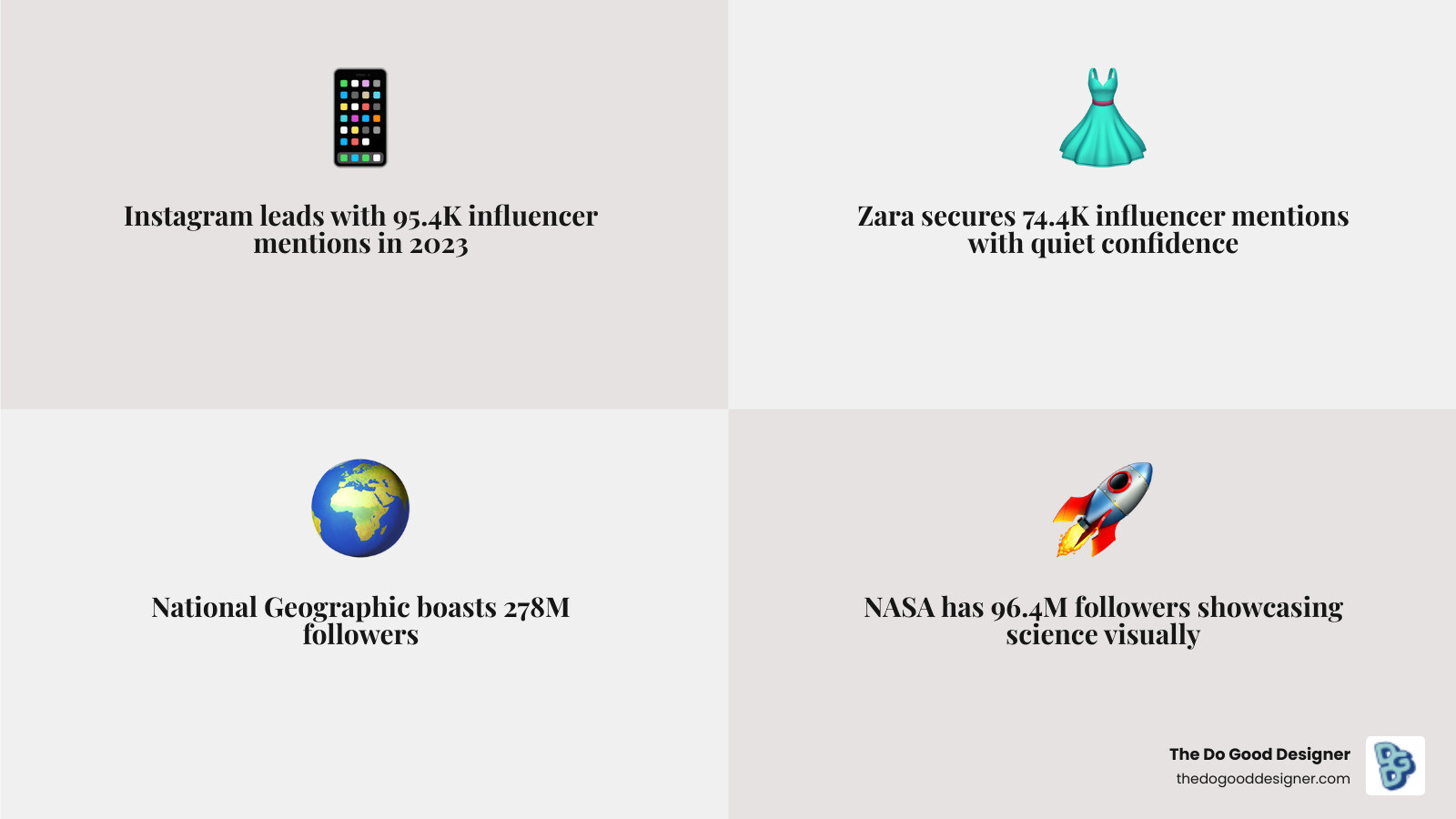
- Instagram - 95.4K influencer mentions in 2023 (yes, the platform itself tops the list)
- Zara - 74.4K influencer mentions; proof that quiet confidence wins
- National Geographic - 278M followers and counting
- NASA - 96.4M followers; science has never looked this good
- Huda Beauty - 23.4M followers built on authenticity and humor
- GoPro - 20.7M followers powered almost entirely by user-generated content
- Liquid Death - 7.1M followers and a $1.4B valuation from selling water
- Glossier - 3.2M followers built slowly, intentionally, community-first
These aren't accidents. Every one of these brands made deliberate choices about how they show up visually, how they talk to their audience, and what they stand for.
Instagram has over 2 billion monthly active users. The competition for attention is real. And yet some brands cut through the noise effortlessly while others keep posting into the void.
This list breaks down exactly what separates the winners from the wallpaper.
I'm Allie Laing, a graphic designer based in Omaha, Nebraska — and after a decade of building brands and visual identities (including my own), I've spent a lot of time studying what makes the best brands on Instagram work. That experience shapes everything I share here.
What Makes the Best Brands on Instagram Stand Out in 2025?
The algorithm has shifted. We've moved away from a chronological feed of friends to a discovery engine that prioritizes content people actually want to save and share. In 2025, the best brands on Instagram are those that stop scrolling by offering something more than a sales pitch.
Authenticity is no longer just a buzzword; it’s a requirement. Research shows that Instagram creators with 1,000–5,000 followers have the highest average engagement rate at 4.6%. This tells us that intimacy and real connection perform better than massive, polished broadcast campaigns.
Format matters, too. Reels currently get 36% more reach than carousels and a staggering 125% more reach than single-image posts. But reach is only half the battle. To actually convert a viewer into a follower, you need trust. According to recent data, 82% of consumers are more likely to buy from a brand if it incorporates user-generated content (UGC) into its marketing. People want to see how real people use your products in the real world.
How the Best Brands on Instagram Use Relatable Humor
One of the fastest ways to build a community is through shared laughter. Some of the best brands on Instagram have completely abandoned the "corporate" voice in favor of something unhinged and deeply relatable.
Take Liquid Death, for example. They sell water in a can, but their Instagram feels like a comedy show. By using the slogan #MurderYourThirst and collaborating with celebrities like Steve-O and Travis Barker, they’ve turned a commodity into a cultural phenomenon. Their "God metric" isn't just likes; it's shares.
Other brands using "unhinged" humor effectively include:
- Wendy’s: Known for roasting competitors and acting like a friend with zero filter.
- Brita: They capitalized on a viral (and weird) trend of people filtering vodka through their pitchers. Instead of ignoring it, they leaned in with bizarre, serialized content that made them the fastest-growing home care brand in late 2022.
- Yahoo!: They’ve found a niche in "office humor," posting memes about "per my last email" energy that resonate with every burnt-out professional.
The lesson here? Don't be afraid to break character. When a brand feels like a person with a sense of humor, it becomes much harder to scroll past.
Why Visual Consistency is the Secret Weapon for the Best Brands on Instagram
While humor builds the community, visual consistency builds the brand. I'm a firm believer that the world needs less boring walls—and less boring feeds. Visuals shouldn't just be "pretty"; they should be strategic.
Sweetgreen uses what experts call "sensory marketing." Their food photography is cinematic and high-production, designed to evoke a physical response (hunger) and an emotional one (aspiration). On the luxury side, Rolex maintains a stunningly vibrant feed that focuses on the intricate details of their products, paired with captions that reinforce their heritage.
When I work on a project like A Brand System with Iconic Style, the goal is to create a visual language that works across every touchpoint. On Instagram, this means having a recognizable color palette, consistent typography, and a "vibe" that users can identify without even looking at the handle. Research suggests that while 85% of organizations have brand guidelines, only 30% actually enforce them. The brands that do enforce them are the ones that stick in our minds.
Leveraging User-Generated Content and Community Insights
The best brands on Instagram let their customers do the talking. GoPro is the gold standard for this. By sharing high-octane videos captured by their users, they’ve built a feed that feels like a collective adventure rather than a product catalog. They even opened regional handles to feature localized content, which helped grow their total base to over 20 million followers.
Airbnb does something similar by featuring awe-inspiring photos of accommodations taken by guests. They also leverage big names like Sabrina Carpenter and Patrick Mahomes to promote "Experiences," bridging the gap between celebrity lifestyle and user reality.
Even data can be community-driven. Oura (the smart ring brand) taps into niche user habits, like checking sleep scores the moment you wake up or the "Oura Ring tan line" that happens in the summer. It’s a way of saying, "We see you, and we get you."
I saw this power when Branding the Adidas Tailgate for the Largest Women’s Sporting Event in World History. When you create a space (physical or digital) where people feel represented and excited to share their own photos, the brand grows organically.
Building a Brand That Lasts Beyond the Hype
As a designer, I’m not interested in making things just to make things. I want to build brands that have a point of view. The best brands on Instagram in 2025 are purpose-driven. They balance product promotion with cultural commentary or activism.
Patagonia is a prime example. Their feed is as much about environmental activism as it is about outdoor gear. Ben & Jerry’s takes a similar approach, campaigning for prison reform one day and celebrating National Chocolate Ice Cream Day the next. While this can be polarizing, it builds deep loyalty with customers who share those values.
If you’re a small business owner in Omaha or anywhere in the Midwest, your size doesn't matter—your vision does. Whether you need Logo Design & Brandings or a complete brand refresh, the goal is to find that unique "Do Good" angle that makes your audience care. You can learn more about my personal approach to design on the About page.
How Niche and Streetwear Brands Find Their Tribe
You don't need a billion-dollar valuation to win on Instagram. In fact, there is a massive community of people on Reddit and beyond looking specifically for "low-key" brands. These users are tired of "hypebeast" trends and drop-shipped products. They want authenticity.
Small streetwear brands find success by:
- Avoiding "mockup fatigue" (don't just Photoshop your logo on a t-shirt; show the real thing).
- Using niche hashtags that are relevant but not over-saturated.
- Engaging in the comments of curator accounts like @ownthinguk.
When I designed the Original Merchandise Collection for Tinder and Tinder University, the focus was on creating something that felt exclusive yet wearable—the kind of "if you know, you know" vibe that thrives in niche communities.
From B2B to Beauty: Adapting Strategy to Your Audience
The strategy that works for a beauty brand won't necessarily work for a software company, but the underlying principles of good design and engagement remain the same.
Beauty Brands (Huda Beauty, Glossier, Sephora):These brands thrive on "realness." Huda Kattan of Huda Beauty often shares unpolished hacks (like tape contouring) or real skin treatments. They use Reels to show product performance in real-time, which is essential for building trust in the cosmetics space.
B2B Brands (Shopify, Mailchimp, Notion):B2B doesn't have to be boring. Shopify uses carousels to create educational "how-to" guides for entrepreneurs. Mailchimp uses tongue-in-cheek humor and in-jokes that digital marketers appreciate. Notion takes a "slow growth" approach, focusing on providing consistent value to their community rather than chasing every viral trend.
Whether you're selling a salad, a software subscription, or a hand-painted mural, the best brands on Instagram are the ones that treat their followers like people, not just data points. They use high-quality visuals, a consistent voice, and a dash of humanity to turn a social media feed into a thriving community.